Whisper X GUI
Built to save the Social and Administrative teams hours of manual transcription: a Python pipeline that cleans the audio with ffmpeg, transcribes with WhisperX (word-level timestamps) and identifies who is speaking with pyannote. Everything runs locally, on the desktop or from the browser with the Docker version.
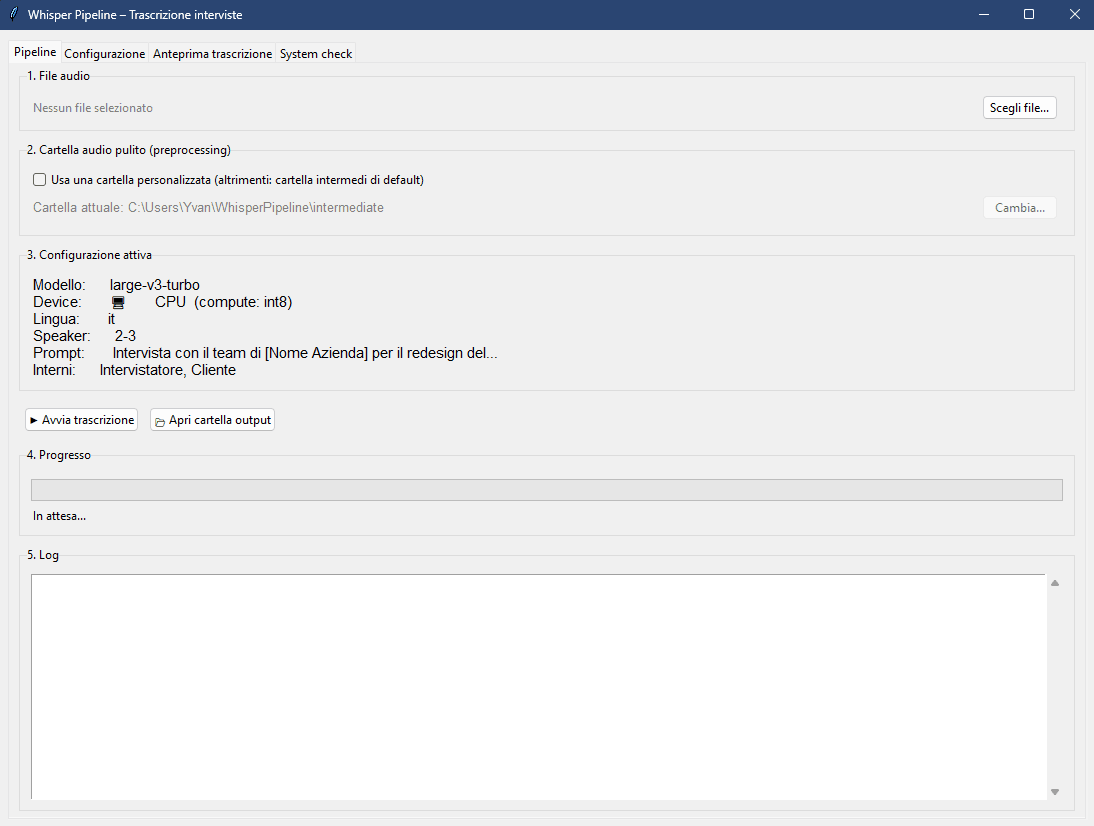
Challenge I solved
Transcribing an audio recording used to take days of work: hours of recording to replay, pause and type out by hand. Now the pipeline does the transcription — with timestamps and speaker names — and all that's left is reviewing the result and, if needed, feeding it to an AI to get a list of the key points of the conversation.
Why I built it
The program was created to help the Social and Administrative teams transcribe the audio recordings of client meetings and, when needed, internal ones. This task used to take hours, sometimes days of work; now it only takes the time the audio needs to be processed, and the transcript can then be handed to an AI to produce a bullet-point summary of the meeting.
Screenshots
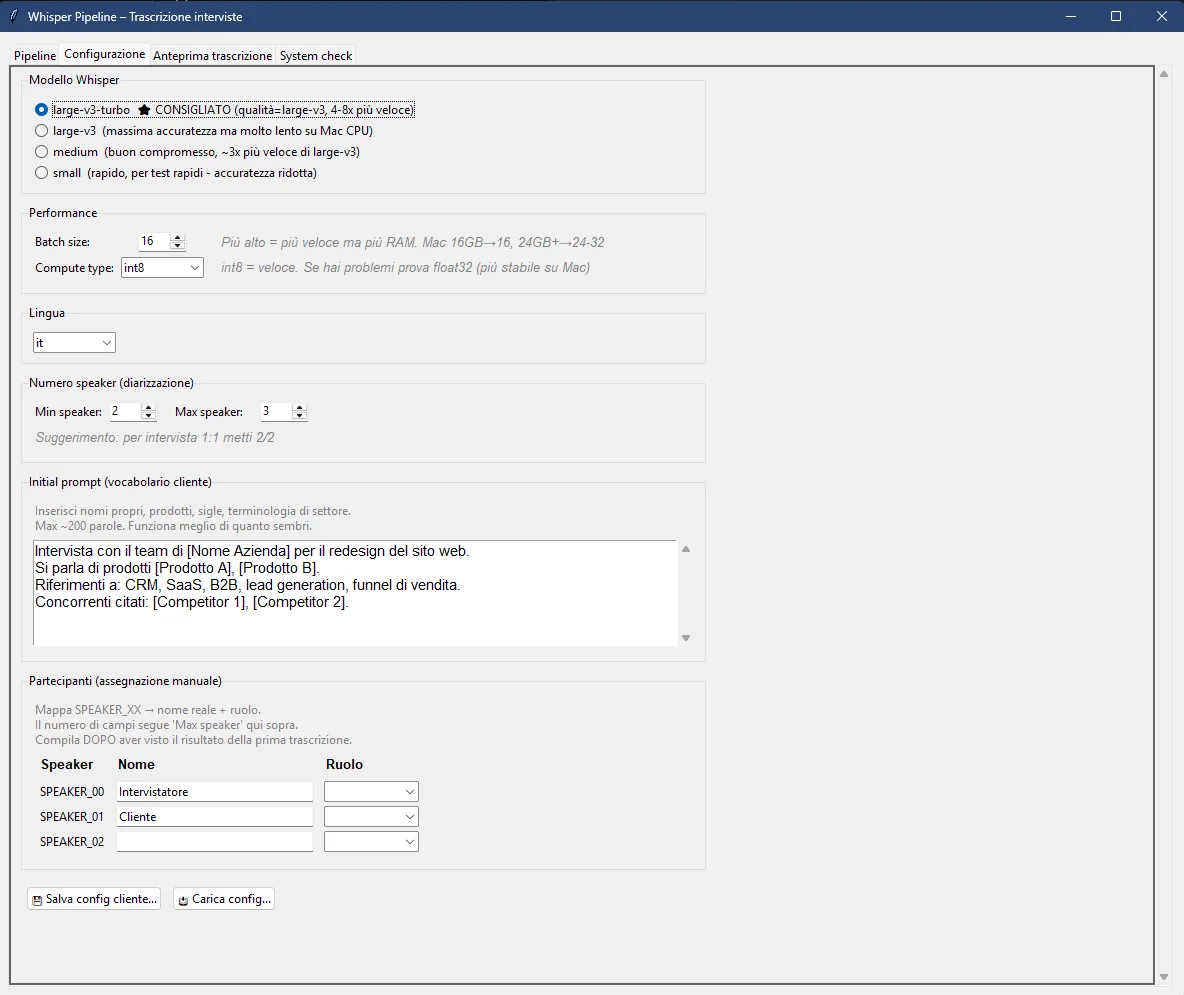 The configuration tab: Whisper model choice, speaker count for diarization, client vocabulary (initial prompt) and mapping of speakers to real names, with per-client saveable configs.
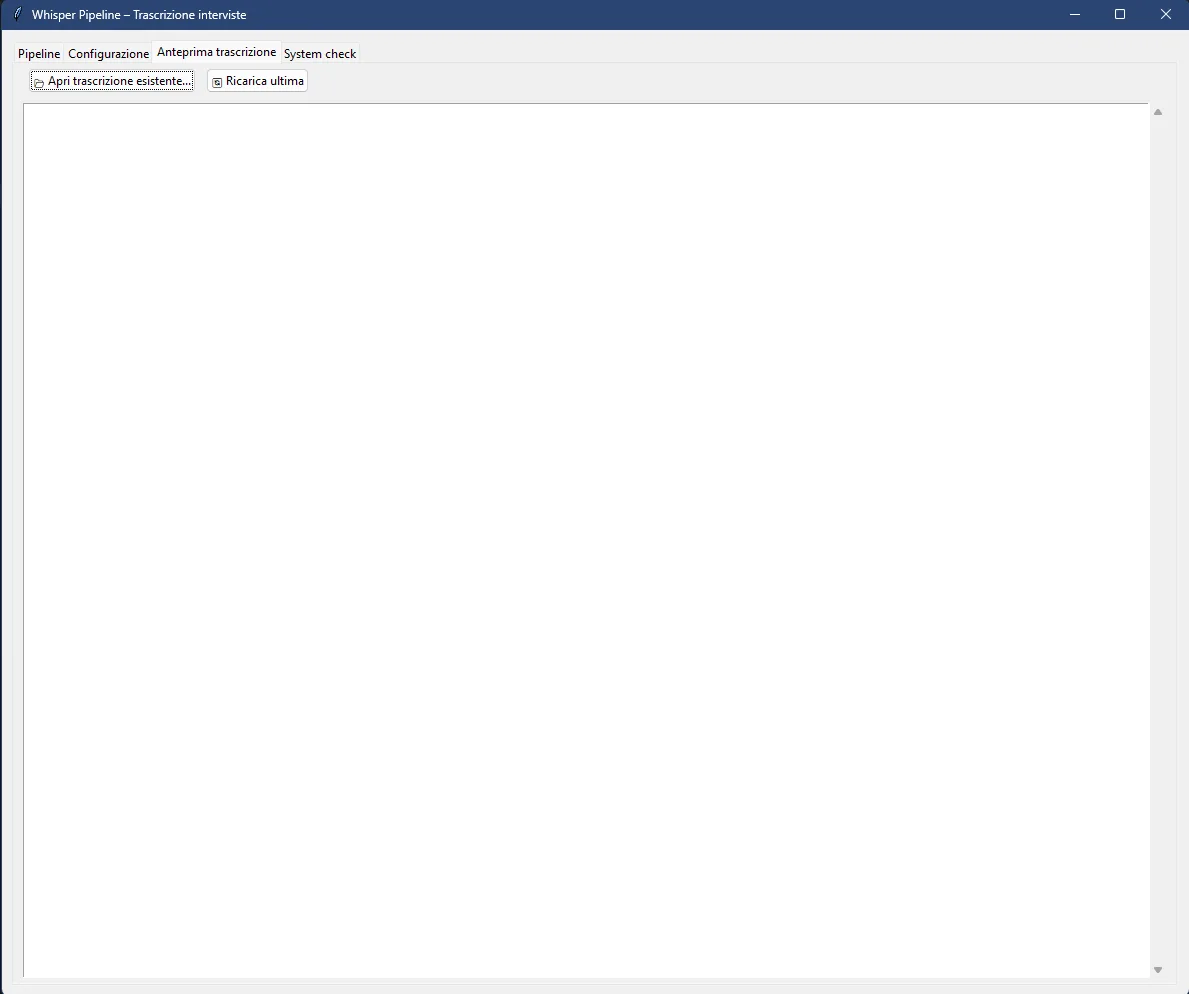 The built-in preview: reopen the latest transcription or load an existing one without leaving the app.
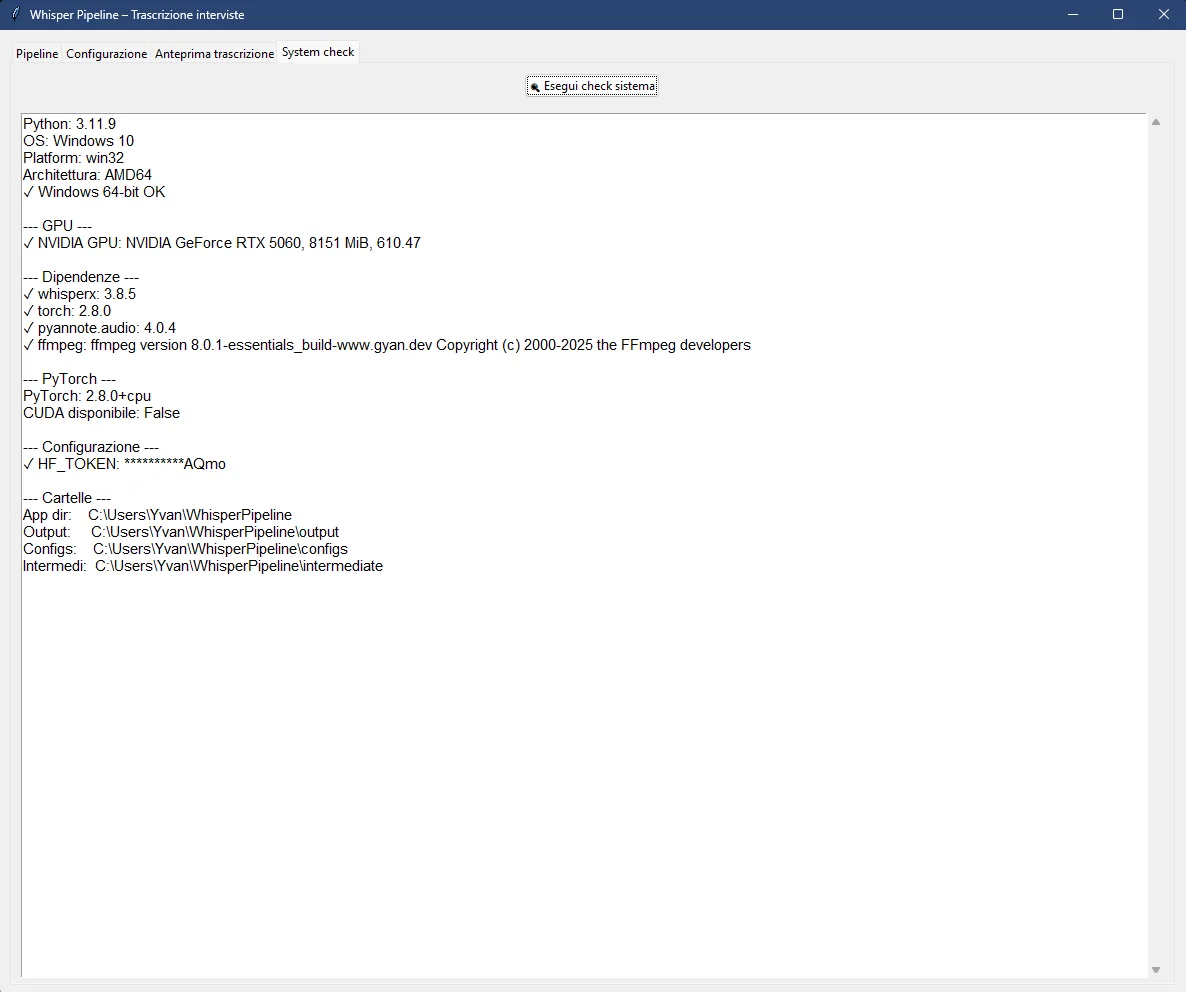 The system check: verifies Python, the GPU, dependencies (WhisperX, PyTorch, pyannote, ffmpeg), the HuggingFace token and working folders.
Tech stack
The program is written entirely in Python. Python was chosen because the whole automatic transcription ecosystem (Whisper, pyannote, PyTorch) lives there, and the project started as a desktop application with a tkinter GUI, running on both macOS and Windows. At its core is a staged pipeline: the audio is first cleaned up with ffmpeg (filtering and loudness normalization), then transcribed with WhisperX (Whisper, large-v3-turbo model), timestamps are aligned at word level, and finally pyannote.audio identifies who is speaking (speaker diarization). The result is exported as readable Markdown, full JSON, and SRT subtitles. Everything runs locally, with NVIDIA GPU acceleration when available: no cloud, no paid APIs — the models are downloaded just once from HuggingFace. Over time, a Docker version was added for deployment on a company server: it exposes a web interface with exactly the same features as the GUI (FastAPI backend, HTML/JavaScript frontend), so anyone on the network can use the program from their browser without installing anything on their machine.